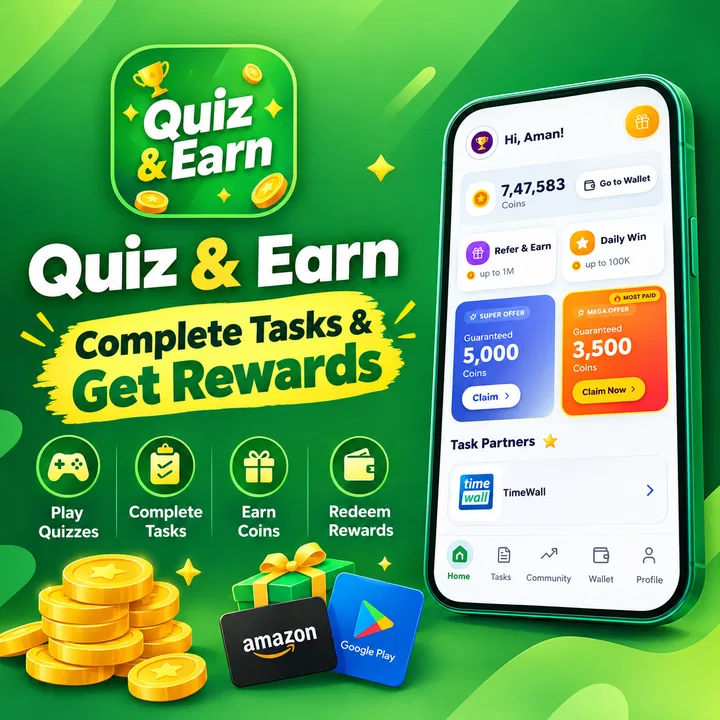
Redeem code app - Quiz & Earn
- 4.9
- Rating
- 1.00M
- Installs
- Free
- Price
 Analysis by App-foxy
I approached Redeem code app - Quiz & Earn as a trivia game first and a rewards app second. That distinction matters. Its central appeal is not simply answering questions for entertainment; it is the possibility of completing activities, joining tournaments, and working toward gift codes. In my experience, that makes the app more interesting than a standard quiz when I have a few spare minutes, but it also means I judge it by two standards: whether the trivia is enjoyable and whether the reward journey feels clear enough to justify the time.
The game is free, aimed at everyone, and comes from Gestión Empresarial 3000. It has reached over one hundred thousand installs and holds a 4.8 average from around fifty-five thousand ratings, which suggests that the basic idea has connected with a substantial audience. I would still avoid treating those figures as a guarantee that every player will enjoy it. Reward-focused games suit people who like small goals and repeated sessions; they are less attractive to anyone who wants a deep quiz database, a completely distraction-free experience, or instant rewards.
How I would decide whether it is worth using
Before installing, I would ask myself what I actually want from a trivia app. If the answer is “a quick mental challenge with an extra incentive,” this game makes sense. If I want carefully structured learning, long-form explanations, or a competitive quiz platform built around knowledge alone, a conventional trivia title may be a better match. The reward layer changes the experience, so it should be part of the decision rather than an afterthought.
You May Also Like

 Blood Strike: 2.5 Anniversary
Blood Strike’s Loadouts Turn Every Drop Into a Tactical Gamble
A close look at Blood Strike’s custom loadouts: how fast access to signature weapons reshapes its battle royale rhythm, rewards preparation, and narrows the gap between fights.

 Pandora - Music & Podcasts
Pandora’s Music Is Easy to Start, but Harder to Recover
Pandora’s strength is its low-effort path from a seed to a station. Its weak spot is how much confidence it asks you to place in connection, setup, and quiet recovery.

 8 Ball Pool
 Is Built on Rivalries, Rematches, and Routine
A close look at the rivalries, rematches, shared routines, and unanswered safety questions that turn a quick pool match into a persistent mobile community.

 Samsung Music
’s Quiet Strength Is Playing What You Already Own
Its reach comes less from spectacle than from dependable access to a personal library. That simplicity is both the app’s strongest retention engine and its ceiling.

 AccuWeather: Weather Radar
AccuWeather Review: A Quick, Clear Forecast for Everyday Decisions
For everyday plans, the best forecast is the one you can understand quickly. AccuWeather makes rain timing, radar, and local conditions easy to act on, with a few trade-offs.

 Hill Climb Racing
Why Hill Climb Racing Still Turns Crashes Into One More Run
A tiny car, a bumpy hill and one more upgrade: Hill Climb Racing keeps resurfacing because its simple chaos makes every near-miss feel personal.
More From Our News Desk



I also look at how much patience I have for gradual progress. The store summary presents a loop built around completing tasks, winning tournaments, and obtaining real gift codes. That wording points to a process rather than a single action. I would therefore use it with the expectation that progress depends on engaging with the available activities, not on opening the app once and immediately receiving something valuable.
The most useful test is whether the questions themselves hold my attention. Rewards can encourage me to return, but they cannot make weak trivia satisfying for long. During a short session, I want the questions to feel like a genuine challenge rather than an obstacle between me and a prize. Anyone considering the game should give that balance priority: if the quiz portion feels entertaining, the reward system becomes a welcome extra; if it feels repetitive, the incentive may not be enough to keep playing.
A practical way to use it during the day
My preferred use case is a series of short sessions. For example, I might open the game while waiting for an appointment, complete a few available tasks, and leave rather than forcing myself to continue when my attention drops. This approach keeps the app in the “small break” category and prevents the reward goal from turning into a chore.
I would also keep a simple personal note of what I have completed and what I am still working toward. That is not a glamorous tip, but it helps when an app combines multiple activities and tournaments. Instead of relying on memory, I can decide whether the next session is best spent answering questions, checking a competition, or reviewing the path toward a gift code. The benefit is less wasted time and a clearer sense of progress.
Another sensible habit is to read each task carefully before starting it. In reward-based games, the difference between “participating” and “finishing” can affect how useful a session feels. I would not assume that opening a tournament, answering one question, or completing a partial activity is equivalent to reaching its intended goal. Paying attention to the wording helps me choose activities I can realistically finish in the time available.
What makes the reward structure appealing
The strongest idea here is the combination of trivia and a visible purpose. A normal quiz can be enjoyable, but once I have answered enough questions, I may have little reason to return beyond habit. This game adds a practical target through gift codes, so even a brief session can feel connected to a larger objective.
Tournaments add another layer for players who enjoy comparison and urgency. I like that this gives the experience a different rhythm from answering isolated questions. A tournament can make me concentrate more carefully, while ordinary tasks may be better suited to relaxed play. That variety is valuable because it prevents every visit from feeling identical.
The game is also approachable for people who do not usually play complex mobile games. Its trivia focus is easier to understand than a title requiring elaborate controls, character builds, or a long tutorial. Someone can arrive with the simple goal of answering questions and exploring the available reward activities. That accessibility is one reason I can imagine recommending it to a friend who wants something lightweight rather than a demanding game.
The real strength is the fit between short trivia sessions and a gradual reward goal. It works best when I treat the app as a small routine, not as a guaranteed shortcut to valuable items. That mindset makes the experience more honest and more sustainable.
Three details that improve the experience
First, I would separate entertainment from progress. I can enjoy a quiz round even when it does not immediately move me toward a gift code. This prevents every incorrect answer from feeling like a financial loss and lets me judge the app on its actual gameplay. If I only care about the reward, frustration is likely to arrive quickly.
Second, I would choose a consistent session length. A short, repeatable routine is easier to maintain than opening the game whenever I feel vaguely bored and then spending too long inside it. This is especially useful for a rewards app because the temptation is to continue chasing the next milestone. Setting a personal stopping point keeps the game from taking over a break that was meant to be brief.
Third, I would treat tournaments as focused events rather than something to enter automatically. If I am tired or distracted, a competitive quiz may not be the best use of my time. I would reserve those moments for when I can read questions carefully, while using ordinary tasks for casual sessions. That small distinction helps me get more from the different parts of the game without assuming that every activity serves the same purpose.
Where it wins, and where another type of app may fit better
Compared with a traditional trivia game, this title has a clearer practical motivation. A standard quiz usually asks me to play for knowledge, score, or personal improvement. Here, tasks and tournaments are tied to the possibility of real gift codes. For a player who likes rewards and already enjoys trivia, that is a meaningful advantage. I can understand why the app has attracted strong user interest.
Compared with a general rewards app, it has a more focused starting point. I am not entering only to browse offers or complete unrelated activities; the quiz format gives the experience a recognizable game identity. That makes it easier for me to return when I want a question-based break rather than a broad rewards dashboard.
However, a conventional educational quiz may be preferable for someone who wants explanations, subject-based study, or a structured learning path. I would also choose a pure trivia game if my main priority were a polished competition without reward-related goals. The more I care about knowledge depth and quiz design, the less important the gift-code angle becomes.
There is also a personality difference. Players who enjoy checking tasks, pursuing milestones, and waiting for progress to accumulate may find the system motivating. Players who dislike repeated objectives or who expect immediate results may find the same structure tiring. Neither reaction is wrong; it depends on whether the reward loop feels like encouragement or administration.
Who should skip it
I would skip this game if I want a completely predictable experience with no reward-oriented layer. I would also look elsewhere if I need a trivia app for serious study, because the appeal here is the combination of questions, tasks, tournaments, and gift-code goals rather than a dedicated academic curriculum.
It may not suit someone who becomes frustrated when a reward requires sustained participation. The store summary makes the activities sound connected to earning, so I would not install it expecting a one-tap exchange. Anyone who dislikes gradual goals should choose a game where the satisfaction comes directly from the score or the questions.
Finally, I would avoid making it my only mobile game if I need rich variety, deep strategy, or a large social experience. Its identity is specific: trivia with a reward objective. That focus is a benefit for the right audience, but it naturally limits what the app is trying to be.
What to expect before committing time
The game is free, which makes trying it low-risk in terms of purchase cost. I can install it, see whether the questions and task flow suit me, and stop if the routine does not feel worthwhile. The more important cost is attention. Every reward game asks me to decide whether the time spent is justified by the enjoyment and progress I receive.
I would also pay attention to the app’s current presentation after installation. Its current version is 264, and it supports Android 7.0 or later, so compatibility should be checked against the device before planning to use it regularly. That is a practical detail, especially for someone using an older phone or tablet.
The age rating of Everyone makes the concept broadly approachable, but I would still encourage younger players to use sensible judgment around any app built around rewards. The game may be accessible to a wide audience, yet the best experience comes from treating gift codes as an optional outcome rather than something to chase without limits.
One trade-off is that the reward goal can change how I answer questions. Instead of thinking carefully, I may be tempted to rush through tasks just to advance. I get better value when I slow down enough to enjoy the trivia and use mistakes as feedback. If the app becomes a repetitive checklist, I would take a break rather than forcing another round.
The switching cost is mostly about habits
Moving from a regular trivia game to this one is easy if I already like short quiz sessions. The familiar part is answering questions; the new part is organizing my attention around tasks, tournaments, and reward progress. I would not need to abandon my existing quiz app immediately. I could use this title when I want an incentive and return to the other one when I want a purer knowledge challenge.
Switching away from this game is equally simple if the reward structure does not suit me. Since it is free, the main thing I lose is the routine I have built around checking progress. That makes experimentation worthwhile: I can test whether the combination feels motivating without committing money to it.
The larger cost appears when I start measuring every session only by the reward outcome. At that point, changing to a standard trivia game may feel less satisfying because there is no external target. I avoid that problem by deciding in advance what I want from each visit: entertainment, a tournament attempt, or progress on a task. Clear intent makes it easier to compare the app fairly with alternatives.
My recommendation
I recommend Redeem code app - Quiz & Earn to people who enjoy trivia and like the idea of working through activities toward gift codes. It is especially suitable for short breaks, casual players, and anyone who finds a reward goal more motivating than a score alone. The strong average rating and broad install base make it worth trying, but I would still judge it by the quality of my own sessions rather than by popularity.
I would not recommend it as a replacement for a serious learning tool or a pure competitive quiz platform. Those alternatives are better when explanations, subject depth, or score-focused competition matter more than rewards. This game has a narrower purpose, and it is most successful when I accept that purpose instead of expecting it to cover every kind of trivia experience.
My final advice is to start with a modest routine: explore the available tasks, try the trivia, see how tournaments fit your style, and decide whether the progress feels enjoyable. Keep the reward objective in perspective, and stop using it if the time investment no longer feels fair. For the right player, this is a friendly way to turn spare minutes into quiz sessions with an added incentive. For everyone else, a conventional trivia app may deliver a cleaner and more focused experience.
FAQs for Redeem code app - Quiz & Earn
01What is the main purpose of the Redeem Code app - Quiz & Earn?
The Redeem Code app - Quiz & Earn is designed to let users engage in fun quizzes while earning redeemable points. These points can be exchanged for various rewards, such as gift cards or discounts. The app combines entertainment with the opportunity to earn rewards, making it appealing for users looking to make the most of their leisure time.
02How do I earn rewards using the Redeem Code app?
To earn rewards, users participate in quizzes that cover a wide range of topics. Correct answers earn points, which accumulate over time. Once a certain threshold is reached, these points can be redeemed for rewards like gift cards or discount codes. The app ensures a balance between enjoyment and reward accumulation.
03Is the Redeem Code app - Quiz & Earn free to use?
Yes, the app is free to download and use. However, it may offer in-app purchases or optional premium features that enhance the user experience or accelerate point earning. It's designed to be accessible, allowing users to enjoy quizzes and earn without any initial investment, making it appealing to a wide audience.
04What types of quizzes are available in the app?
The app offers a diverse range of quizzes covering topics from general knowledge and pop culture to science and history. This variety ensures that users of all interests can find quizzes that appeal to them. The questions are regularly updated to keep the content fresh and engaging, encouraging users to return frequently.
05Are there any age restrictions for using the Redeem Code app?
Yes, the app is generally intended for users aged 13 and above, in compliance with digital privacy laws. It’s important for younger users to have parental guidance when using the app, especially when redeeming points for rewards. This ensures a safe and responsible usage environment for all participants.
Pros
- Easy-to-use interface.
- Wide variety of quizzes.
- Engaging reward system.
- Frequent updates.
- Supports multiple languages.
Cons
- Ads can be intrusive.
- Requires stable internet.
- Limited quiz categories.
- Occasional app crashes.
- Redeem options are limited.

Redeem code app - Quiz & Earn
Gallery